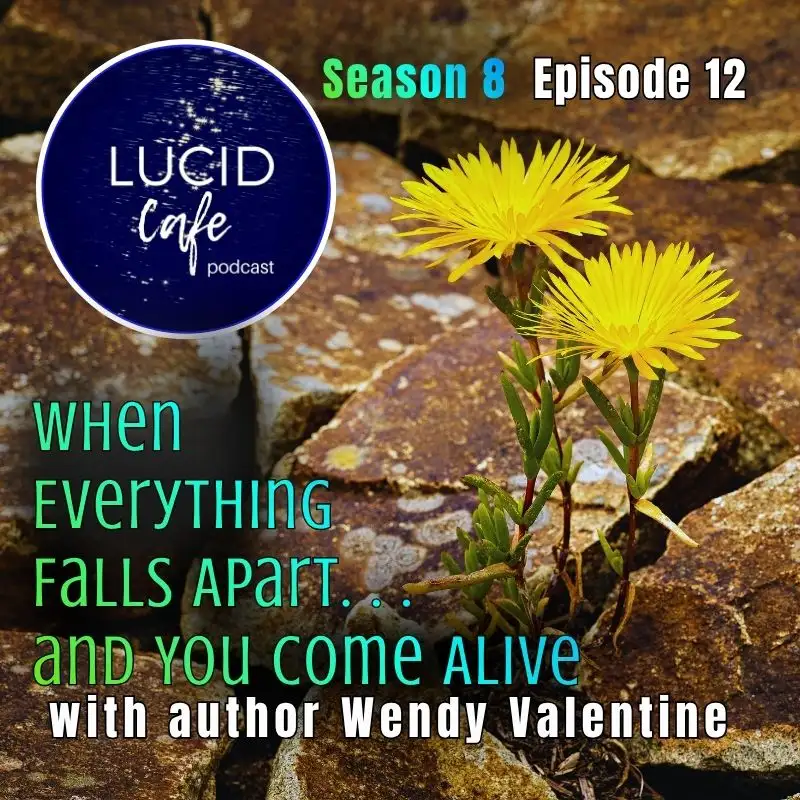
When Everything Falls Apart...and You Come Alive with Wendy Valentine
You're listening to Lucid Cafe. I'm your host, Wendy Halley. Hi. Thanks for joining me. Let me start this episode with a big old atta-girl because I'm on a roll.
wendy:I've managed to get a new episode out every two weeks for how long has it been? It doesn't matter. Time's fucked up anyway. The point is it's happening and what makes this feat even more mind blowing to me is that my friend Sarah Finley and I just released the first two episodes of our new weekly podcast which is called Realms of Curiosity with Sarah and Wendy. We decided to go in a very different direction with this show.
wendy:Through candid unscripted conversations, Sarah and I explore shamanism, consciousness, intuition, the dream time and the evolving nature of human awareness. With roots in psychology and decades of shamanic practice between us both, we share personal stories, otherworldly experiences, and reflections on a rapidly changing world. We don't claim to have answers. Instead, we follow our curiosity into the unknown, questioning, exploring, and inviting you to do the same, because in times like these, curiosity might be one of the most powerful tools we have. So you can listen to Realms of Curiosity wherever you listen to podcasts or you can watch the video version of the show on YouTube.
wendy:That's right folks we got a video version of this show. And as of right now, episodes come out every Saturday. Alright, so back to this podcast. I sure had a fun and lively conversation with my guest Wendy Valentine. Midlife isn't what it used to be and for many women it can feel like everything is unraveling all at once.
wendy:Wendy Valentine knows that experience firsthand. She's the author of Women Waking Up The Midlife Manifesto for Passion, Purpose and Play and in this conversation she reframes the so called midlife crisis as an awakening. She shares how she moved through profound loss, burnout and uncertainty and how choosing bold imperfect action helped her rebuild a life aligned with who she truly wanted to be. As you'll soon discover Wendy is all about helping women kick fear to the curb, reignite their spark, and wake up to what's possible. So please enjoy my conversation with Wendy Valentine.
wendy:Wendy, thank you for joining me.
Wendy Valentine:Wendy, I just love your name, Wendy. Do you say it Wendy or when so I've always said it Wendy and people are like, oh, w I n d y. I'm like, actually, it's w e. And they're like, should be Wendy. I was like, Wendy.
Wendy Valentine:I can't say Wendy. Do I say my name?
wendy:Never paid attention. Wendy. Guess I say it more with the e. Wendy. Wendy.
wendy:Wendy. Wendy.
Wendy Valentine:You better keep this part. Don't you edit this part.
wendy:We're not gonna edit this part out. No. This is podcast gold right here.
Wendy Valentine:It's the Wendy and Wendy show.
wendy:Yeah. Well, if you were a lot weirder, it'd be like talking to myself.
Wendy Valentine:I know. I can be weird. I ain't got no problem.
wendy:Alright. Well, bring it.
Wendy Valentine:Don't judge a book by this cover right here. Well,
wendy:I'm psyched that you're on the show, and we're going to talk about your new book. You're covering territory that I'm not aware that anyone else has covered before. So can women have a midlife crisis?
Wendy Valentine:I guess it depends on how you look at it. I like to say it's a catalyst. Try to like flip the script on this
wendy:Nice reframe. So we're not talking the red Corvette and the young secretary.
Wendy Valentine:I mean, if you want to.
Wendy Valentine:We always can. I mean, the reality is, right, especially like your twenties and thirties, you're checking off all the boxes, the kids, career, marriage, house in the burbs, and then your forties and fifties roll around. And whether you like it or not, life is going to change. Those birdies leave the nest. Your career's usually changing.
Wendy Valentine:Maybe it's just even within the same company or completely different job. Your marriage is changing usually, your parents are aging, your body is aging, hello menopause.
wendy:Don't know what you're talking about.
Wendy Valentine:Yeah, exactly. So yeah, you have a choice. You can look at it as a crisis. You can look at it as a catalyst. And really, it's like it's up to each person of what they do with it.
Wendy Valentine:You can fight the changes or you can evolve with them and rise above them. I love I'm 52 now. I love the fifties.
wendy:Do you? You wanna marry me?
Wendy Valentine:Yeah. Yeah. And I I've even I've heard the sixties are even better.
wendy:I'll let you know.
Wendy Valentine:Yeah. Let me know. Let me know. But, you know, it wasn't until I'm gonna tell you my breakdown and breakthrough story. The reason I wrote this book.
wendy:Okay. I was gonna ask. Yeah.
Wendy Valentine:Yeah. Honestly, it was the book that I needed. Mhmm. I wish I'd had my book seven years ago, but 45 years old, I was going through divorce, unemployment. I was probably $150 in debt, chronic illness.
Wendy Valentine:I had Lyme disease, black mold toxicity, and good old menopause. Just toss that in there for fun. And within a six week period, my dog died, my cat died, and then my brother died.
wendy:Oh my.
Wendy Valentine:And needless to say, I went into a deep depression, suffered from first time ever really like having panic attacks. I'd never really had panic attacks before.
wendy:Not fun.
Wendy Valentine:Not fun. The scary as shit. It just, like, hits you out of the blue. Yeah. Yeah.
Wendy Valentine:45 years old, I was literally laying on my bathroom floor, bawling my eyes out, thinking like, oh my gosh. My life is over. And I was also almost an empty nest. I have three boys. One of them was still at home, almost out of the nest there.
Wendy Valentine:And I just had this realization. I was like, wow, I'm gonna be turning 50 in the next few years and my life is a mess. And what am I gonna do? So I had this vision kind of like, let's say your dad had the dream about you know, having a daughter named Wendy.
wendy:Yeah, we were talking about this before we started recording.
Wendy Valentine:And I had this dream, this vision of driving an RV across the country.
wendy:Okay, very similar types of Yeah.
Wendy Valentine:Mean, similar. You know, it's kind of the it's kind of the windy thing, you know? And I remember sitting there, I think I was like, maybe I'm dreaming about this right now because it's like a form of escape. Like, I just wanna I just wanna get the hell out of here. You know?
Wendy Valentine:Like, I just wanted to escape even my own life. I was like, what's sense.
wendy:Yeah. Yeah. Yeah. But And,
Wendy Valentine:like but then all of a sudden, all of the self doubts and the limiting beliefs creeped in. Like, no. There is no way, Wendy, that you can make this happen. You're broke. You have no job.
Wendy Valentine:You're too sick to even drive an RV. And then I thought, well, what if I just went for it? What if what if kind of like George Costanza on Seinfeld when he did opposite day? Well, what if I just do the opposite of everything I've been doing because everything else had not been working out well for me. And so I did.
Wendy Valentine:And I ended up applying for jobs. I sent my resume out that week. Because my first step was I was like, well, I gotta get an I gotta get a job. Right? I mean, to get
wendy:a job to buy pay
Wendy Valentine:for this RV. Exactly. All the things. And I'll I mean, I know I'm kinda skipping ahead, but I was overwhelmed. I mean, I just thought, how in the world am I going to get out from, you know, underneath all of this?
Wendy Valentine:It was such a mess. But let me tell you the first that one of the things that excited me the most about this dream of driving an RV across the country, it wasn't so much the RV or, you know, being in Sedona or something like cruising across in the sunset. You know? It was the woman behind that steering wheel. And I got so excited imagining this happy and healthy financially free woman in the driver's seat, like in the driver's seat of my life, metaphorically.
Wendy Valentine:You wanted to meet her
wendy:so bad.
Wendy Valentine:I was like, we have got to make this happen. I've got to do it. And I finally just gave myself permission to do it, to literally to wake up, to wake I mean, I felt I I was like, not even a crisis. It was more like a coma. I was like, alright, girl.
Wendy Valentine:You got to wake up. We are done with this. It was almost like I was so exhausted from being my old self. I was so tired of the limiting beliefs and the self doubts and the fears and the even the anxiety and the illness. I was so tired of it that I was just willing to just be like, uh-uh.
Wendy Valentine:We're we're going all out. We're gonna make this happen. Sure enough.
wendy:Fuck it.
Wendy Valentine:Yeah. Fuck it.
Wendy Valentine:Yep. Exactly. Yeah. And four weeks later, I ended up I got this job in Chicago selling new construction houses.
Wendy Valentine:I was living in Virginia at the time. Okay. And I was like, I don't know how to sell houses. And I thought, well, what the hell? Why not?
Wendy Valentine:I'll be like George Costanza, total opposite. I'll just I'll figure it out. So I moved to Chicago, start selling houses. And with that whole time with this kind of like in a yoga, you have a drishti. Right?
Wendy Valentine:Like, when you're doing tree pose, you're trying to focus on a dot on the wall. Like, you're just focusing on that the whole time.
wendy:Mhmm.
Wendy Valentine:I kept focusing on that woman driving the RV across the country. That was my focal point. And little by little, step by step, I started, you know, regaining my health, chipping away at the gigantic mound of debt. And two years later, I ended up buying the RV and taking off. Alright.
Wendy Valentine:As that happy and healthy wild Wendy.
wendy:So what would you attribute that transformation to? Because you're talking about, of course, having a goal, and many of us have goals, or a dream for ourselves, but you actually made it come to life. And I mean, I suspect it wasn't just about selling houses. What would you attribute it to?
Wendy Valentine:So I would have to say, and I was, first of all, a perfectionist, people pleaser, approval seeker, codependent, you name it, I had all the labels, and I carried those labels with me for five decades. Okay. And the reason I did is because I always had this fear of abandonment since I was a little girl. And in order to not be abandoned by others, I had to get really good at being perfect so they don't leave me or make sure that everyone around me is happy even if I'm miserable. Right.
Wendy Valentine:But then I realized the number one person that was abandoning me was me.
wendy:That's a big insight.
Wendy Valentine:Huge. Huge. I mean, the greatest of my whole life was that right there.
wendy:Right. Then that makes perfect sense. So we're talking about, well, like, like a very old belief, like a very childlike belief that, well, if I'm a good girl, people will like me and I'll never be alone and no one will reject me. And then yeah, and then coming to that very adult insight of you know what, hey, I'm the one who's rejecting myself. What the hell?
Wendy Valentine:Self abandonment.
wendy:Yeah. And
Wendy Valentine:the other thing is too, being a planner and a perfectionist, I used to never leap until I had everything perfectly planned out.
wendy:Which makes sense, a certain degree But of
Wendy Valentine:then I would never leap because nothing was ever perfect. It was what paralysis by analysis. Right? And so I finally had to just give myself permission to leap. Leap and the net will appear.
Wendy Valentine:I had to leap and figure the thing everything out. And and, you know, it was also instead of worrying about the what, when, where, and how as we typically do, we have the list and all the things like the goals and all of that, which can be great, but we tend to forget the who. And so, like, who are we gonna be? Who who? And that was the one thing I focused on.
Wendy Valentine:I focused on the woman that I wanted to be, not what society wanted, not what my friends, family, parents, kids, uh-uh, me. Who do I wanna be? And I started I'll never forget this. My aunt Annie had told me she's like the greatest sounding board on the planet. And she's like, Darling, you always wanted to be an actress.
Wendy Valentine:So why don't you just act like the woman you want to be?
wendy:I was like,
Wendy Valentine:I was genius. I know. Every day I literally, I would get out of bed and I would would sit I would meditate on who this Wendy of the future would be. Like, what is she how does she wake up in the morning? How did how does she move her body?
Wendy Valentine:How does she eat? How does she think? How does she feel? What does she say to herself when she looks in the mirror? What are her relationships like?
Wendy Valentine:Like, to the detail. And then every day I would act like this woman.
wendy:Step into that role. The Academy Award goes to but the ironic thing is that I mean, how sad is it for any of us that we have to kind of imagine the ideal version of ourselves when and and then try to strive to be that when we already are that. Mhmm. There's just a bunch of bullshit in the way.
Wendy Valentine:I love that you said that because it reminds me of my favorite one of my favorite metaphors, Michelangelo. When they asked him how he carved the statue of David, he was like, oh, I just I just carved away at everything that was not him. So especially, I think, when we get into our forties and fifties, we're carrying around a lot of heavy marble that was placed there, you know, again, friends, family, society, Instagram, whatever. All the things. Yeah.
Wendy Valentine:So I mean, a lot of times, you know, we we think that we have to learn something new about ourselves or about life, but it's really it's the unlearning. It's the chipping away at the bullshit that is not you. Yeah. And it was never truly you to begin like so deep, deep down there is that angel in the marble. That that is you.
Wendy Valentine:And like you hear a lot today like, oh, be your authentic self. Go ahead, Wendy. I know. Be your true self. Like, I remember thinking Notice
wendy:I didn't use that phrase.
Wendy Valentine:Yeah. Be your authentic self. And I remember thinking that seven years because I was all into the self help books, of course, you know. I read them all and I was like, I don't even know what that means. How do I be true?
Wendy Valentine:I don't know. And I started to evaluate, is this my belief? Are these my values? Is that somebody else's values? Is this what I really like, that ain't me.
Wendy Valentine:You know? So I really started to just pick apart my thoughts, my beliefs, my behaviors, and go, okay. That's not me. That's what he does or that's what she does, but it ain't me.
wendy:So how did you determine what was you and what wasn't you? Like, what was the cause it wasn't an intellectual process, I'm guessing.
Wendy Valentine:Yes and no. But no, I would have to say it was more spiritual. Okay. And to the sense of so as a matter of fact, I had gone to the Tropper Center out in San Diego, and Deepak came in to speak for like five minutes. And we're I was doing a retreat, you know, he's like shows up in his like red Converse and his red glasses, glittery glasses.
Wendy Valentine:And all I remember that he's
wendy:Alright, Deepak.
Wendy Valentine:Yeah, I know. Right? And he goes, you have to feel your way through life. I was like,
wendy:feel your
Wendy Valentine:was way through life. What does the hell does that mean? And I remember when I walked out of there and I had taken my flip flops off and I was walking through the grass and the grass, like, felt kinda, like, nice and cool. And and then I saw like, looked down and there was, a a little crystal in the grass. Oh, cool.
Wendy Valentine:I know. Right? Magic. And then and then it just kinda clicked. I was like, oh, if I just trust myself and what feels good, what does you know, it's like the yum yum principle, right?
Wendy Valentine:Does this feel yum or does this feel yuck? I mean, it's pretty straightforward, you know.
wendy:But simple. It's simple as that. And that's, I think you're hitting on like a great point that we all get lost in is that we are trying to think our way through life. And really, should, as Deepak said, we should feel our way through life, right? Because your body has the truth.
wendy:It'll reveal the truth to you through a felt sense, right? It'll feel right or it will not feel right.
Wendy Valentine:Yes. And I think that the more chipping away that you do the things that are not you, you feel yourself even more. You can tap in easier than Yes. It makes perfect
wendy:sense. Yeah.
Wendy Valentine:Yeah. You don't have all those distractions. And the doubt. Yeah. Exactly.
Wendy Valentine:And I I think too, you know, what I had so many it's it's interesting. Like, once you do give yourself permission to to be you, to to discover more about yourself and about life, like, the epiphanies and the synchronicities is just like, bloop bloop bloop bloop bloop. And for me, what one of the things that I realized was how I did not know this before, but that, you know, an atom I'm gonna get a little geeky on you. An atom is 99.99999 energy, which leaves only point 00001% matter. Why am I saying this?
Wendy Valentine:Because you are made up of atoms, so is your chair, the microphone, your glasses, everything. Everything is energy, and energy is everything. And but what's interesting is that we concentrate on that little tiny bit of matter. Silly yes. Instead of the 99% of energy that we are and when you realize that we're just like swimming in this, you know, big pool of like a, it's like cosmic soup or something.
Wendy Valentine:And we're just crew like when you realize your energy and everything is energy, then you can work with it. You you tap more into that and you don't give a shit about some of the the silliness of life that we that we worry about. I mean, was a chronic worrier so bad. So bad. I mean, just habitual.
Wendy Valentine:Right. And when I realized that, all right, this is all energy and everything's just gonna work its way out however it will, and to not stress so much.
wendy:Yeah. You're also hitting on another really good point, I think. The trust piece is trusting that you'll be okay. It'll work out. And from the energetic standpoint, things I think that the natural state is wanting to move towards harmony.
wendy:And so if you're not in harmony with yourself, then it's going to feel crappy.
Wendy Valentine:Yeah, exactly.
wendy:But there's that part of you that knows that, that something's not right, and then it's a matter of doing a dive into, well, what's not right, and this is your story.
Wendy Valentine:Yeah, there's, I think it was Gandhi that said, happiness is when what you think, you say, and what you do are in harmony.
wendy:Yeah, it's in your book. You put the that quote.
Wendy Valentine:Did I put that in there? Yeah, did. Did it. Do we? I've been like, oh, we should have put that in there.
Wendy Valentine:But and, you know, I remember seeing that quote at Cripallo in Massachusetts. Right. That's and they had it on the wall there. And every time I'd go up the stairs, I'd see it. I was like, interesting.
Wendy Valentine:And I remember thinking at that time back then I was not in harmony and I was not happy. And that's my thoughts, my belief, nothing, nothing was it. Right. Yeah. My thoughts were based upon a ton of horrible negative, you know, memories.
Wendy Valentine:And my beliefs were based on my husband at the time or what my friends were believing or what yeah. All of it. It's just crazy. I was like, none of this is me.
wendy:Right, right. And what a great insight. I'm a long time shamanic practitioner and there's three causes of illness from the shamanic tradition. Fear, disharmony, and soul loss. The disharmony piece is so important that you're bringing up, right?
wendy:Because if you think about that state you were in, you described when we first started talking about being chronically ill, depressed, crying on the bathroom floor, not happy, life transitions looming.
Wendy Valentine:Yeah, yeah.
wendy:And that is like the epitome of disharmony. Like everything, every system in your body was screaming at you. This is not working.
Wendy Valentine:Yep, exactly. And I think that's the key, right? Is to listen to those screams. We tend to wait until our souls or bodies are going, or
wendy:we go to some external expert to have them fix it. And then that's, that never works really either.
Wendy Valentine:Yeah. Yeah, you're so right. I mean, it's, it's the internal expert and you are the expert.
wendy:Even the self help books that even though you wrote one, but that is another way of like, well, maybe this book will be the answer that I need. Yeah. But if the book is pointing you back at yourself like yours is, and and some other ones are doing that as well, then then maybe you're getting somewhere. Yeah?
Wendy Valentine:Yeah. You know, I'm glad you brought that up because when I wrote the book I mean, it's what's the saying? You can lead a horse to water, but you can't make them drink. Right? Like, I can I can lead people to this book all day long, and they can even read the book, but that ain't that's not gonna do anything for you?
Wendy Valentine:Mhmm. And so, I mean, really, the book is probably 30% memoir. Like, you get to hear the breakdown, the breakthrough story, and and then even after I take off in the RV and change my life. But, really, it's 70% guidebook, like, telling you because that's one of the things, like, some of these self help books, which I love them all, were like, that's great and fluffy and wonderful, but how the hell do I do that? You know what I mean?
Wendy Valentine:Like, how do I reach enlightenment?
wendy:It can be it can be daunting. Yeah. And it I think enlightenment is probably overrated. So Yeah. I should probably mention that your book is called Women Waking Up, The Midlife Manifesto for Passion, Purpose and Play.
Wendy Valentine:Yeah, yeah. Yeah, you know, and I want to say to kind of going back to were talking about the shamanism, the the deaths or whatever, is that what you call it?
wendy:Three causes of illness. Yeah.
Wendy Valentine:My opinion, my recommendation, my advice is don't be scared of struggle. Because it's definitely there to teach you something. And I I like the metaphor of a butterfly. Right? If there's you have a butterfly and a chrysalis and you're like, oh, I wanna take it out so it can fly and be free.
Wendy Valentine:And you cut the top of the chrysalis off and you pull the butterfly out, the butterfly would actually be deformed and it would die. So the butterfly has to struggle. It uses so much energy to pump the blood through its veins and for it to push out of the chrysalis so it can fly and be free. The struggle is okay. Yes, it's scary going through it.
wendy:It's not fun.
Wendy Valentine:It's not fun. Yeah. But I mean, I kind of, you know, going, you know, years ago when I went through the dark night of the soul, probably a few times, I now look at it like a it's like a sacred initiation into, like, into your greatest self. Like, it's like the and I can remember back then thinking about the butterflies. Like, yeah, I wanna bust out of this freaking thing, you know?
Wendy Valentine:And you have to go through it. There are no shortcuts. It's just not there's not an easy way to go about it.
wendy:Excellent point. A Yeah. Really good
Wendy Valentine:Honestly, be grateful that that you're alive to go through it. I mean, I think about some of the losses that I've had. Right? Like, my ex husband died at the age of 26. My brother died at the age of 49.
Wendy Valentine:I've had several friends die at a young age, and I think I'm grateful that I'm here and that I like my ex husband didn't even have a chance to make it to quote unquote midlife, right? Yeah. Yeah, I mean, it's I know we say it all the time. So cliche life short you know.
wendy:It really though brings that right front and center, I mean you can't help but take stock of your life when a loved one has died. Yeah, what's important.
Wendy Valentine:Yeah, what's truly important. What's really, really important. You know, the number one regret of the dying is living life for everyone else.
wendy:Ah, that makes perfect I
Wendy Valentine:know. Remember it. Yeah. I think it was Bronnie Ware, her book, Top Five Regrets of the Dying, and that's the number one, is that when she asked all of these people that were on their deathbed, they said, I just regret that I live life for everybody else, but not for myself. That was me.
Wendy Valentine:And
wendy:I I've told this story before in the podcast because it it's one of those really it was I'll tell it really quickly because it's related in case Yeah. People hadn't heard it before, and you haven't heard it. But one of the greatest gifts my mom gave me besides life was she died young. She was 43 when she was diagnosed with cancer, and then died at 45, and I was in my twenties. Mom and daughter relationships are very complicated.
wendy:And she was a tremendous inspiration in my life and also a big pain in my ass. A beautiful dichotomy. The thing that that she taught me through her dying process was the importance of not having regret at that really young age, which was so vital, because I could feel even some of her regrets, she said out loud, and so I knew she was having them. But then others that she didn't, I could just feel it when I would cross the threshold into her hospital room. It would just feel heavy, Like, she was holding on to life with white knuckles, you know, like, I don't wanna go because of all of the what ifs that she didn't get to answer.
wendy:And so I promised myself after she died that I would never ask the question what if. I would just I would just go for it.
Wendy Valentine:I love it.
wendy:No matter what.
Wendy Valentine:That's the that yeah. Exactly. Exactly. That's the title of my next book, actually, what if. Oh, yeah.
Wendy Valentine:Based on that yeah. It's based on that thing. Because I think about that are like, if. Right? What if you do all the things that you say you're gonna do or think about doing?
Wendy Valentine:What if you dropped the doubt and the limiting beliefs and the fears? What if? You know? Like, who would you be? What would your life look like?
Wendy Valentine:Why not find out? What if? What if you found out? I don't
wendy:You don't wanna be on your deathbed wondering or asking that question. What if I had done it? Because then there's no chance at that point to try.
Wendy Valentine:Right. Right. I know. And we'd we don't know. Anything could happen.
Wendy Valentine:Right? Mhmm. There's I'm just full of quotes today. There's the there's the quote from Marianne Williamson, which is one of my faves. And she says, our deepest fear is not that we are inadequate.
Wendy Valentine:Our deepest fear is that we're powerful beyond measure. It is our light, not our darkness that most frightens us. Oh. I know. I remember when, you know, during that time in my life, my breakdown to breakthrough, I remember asking myself the question, what if, Wendy, you fully stepped into your light?
Wendy Valentine:Because I'll admit, the darkness is shitty as it was with the illnesses and the pain and the everything. It was oddly comfortable because it was familiar.
wendy:Exactly. Yeah.
Wendy Valentine:And so I knew that if I fully stepped into my light, that that would mean I would have to file for divorce. I might have to move across the country and take a job I didn't love. Mhmm. I might have to work my ass off for a while to get to the next stage in my life. I might have to go through a dark night of the soul by even which is kind of interesting.
Wendy Valentine:Right? Like, it's the opposite. By by saying, yes, I'm gonna step into my light, I had to go further back into the darkness. Well said.
wendy:Yeah. Is how that Yeah.
Wendy Valentine:I know. I know.
wendy:Because the darkness is part of us too. Yes. Yep. So why not make friends with it?
Wendy Valentine:Yeah. Yeah, exactly. I know. Right? It's it's the dichotomy of life.
Wendy Valentine:Right? You wouldn't know darkness if you didn't know light. You wouldn't know joy if you didn't know sadness. Like, it's just it's part of it. Like, it's, you
wendy:know The human experience. Yeah. Yeah.
Wendy Valentine:The whole spectrum. I don't know why, I mean, I did this all the time. Like, I'm perfect and everything's happy and everything's wonderful. Of course, it's fine. I'm fine.
Wendy Valentine:I'm like, fuck. And that's exhausting, you know, trying to maintain that. Yeah,
wendy:Yeah. And it's yeah. It's actually not fun.
Wendy Valentine:No.
wendy:You're really inviting people to, it sounds like, listen to their hearts and take a risk, or two or three or four or five. Yeah. And then step into the gray, not knowing where it's going to take you.
Wendy Valentine:Yeah.
wendy:And hopefully, eventually learn to trust that you'll be okay no matter what.
Wendy Valentine:That's where the beauty is, I think, when it gets really messy.
wendy:Yeah, tell me more about that.
Wendy Valentine:Yeah. Because I mean, I think of life as a buffet, right? You go sample what you want. See what you like, see what you don't like. If you don't like it now, you know.
Wendy Valentine:If you like it, then cool. Go back for more. But you won't you won't know unless you try. And it's in that giving yourself permission to go up to that buffet line and to sample whatever you want, whether no matter if it's relationships, careers, allowing a gift or strength to finally come out. You know?
Wendy Valentine:Like, anything, just try, who cares? Because just like with your mom, like no fucking regrets. It's just not worth it. And I knew, you know, seven years ago, I remember thinking to myself, okay. I really even though, yes, I had made, quote, unquote, mistakes, I think of them as retakes.
Wendy Valentine:I didn't really I didn't have any regrets, but I knew if if I did not it sounds so silly because it wasn't some again, it wasn't so much the RV experience. It was it was a different life for myself because I knew yeah. There was something There was something not there was some reason I was drawn to take off in an RV. I knew there was more to it, but I knew if I did not do it, it would be my first regret. I was like, I can't do it.
Wendy Valentine:Yeah.
wendy:And the symbolism of that, I mean, to me, it smacks of freedom. Yeah. I'll go wherever I want to go. Yep. I'm driving my house right now.
Wendy Valentine:Like this. Y'all can't you can't see on the video right now, but I always make the steering wheel look like it's a big old trucker or something.
wendy:Yeah, or a giant school bus.
Wendy Valentine:Yeah. No, it's it's interesting. You know, when I wrote this book and came up with it, it was actually the the acronym is freedom. And
wendy:Yes, that's right. Yes, yes.
Wendy Valentine:Yes, I know. It's so funny that you said that. And I remember thinking like, all right, well, found freedom. And then, you know, it's like saying, what does what does success mean to you? You know, Success means something different to everyone.
Wendy Valentine:And I was like, okay. What does freedom mean to me? And freedom for me was just honestly, it was freedom from myself and from from my old self and all the drama in my head and the just and I'm like, it's exhausting. Freedom from toxic relationships and freedom from not not doing what I really wanted to do with my life, being a creative, you know, being a writer and being a speaker, a podcaster, you know, all of that meant freedom to me. But but when I came up with a book, I came up with that acronym, and then I looked back at the two years of my life where I completely just flipped my life upside down.
Wendy Valentine:And then I I was like, oh, I started taking notes. I was like, what did I do? How did I do that? Did I end up here? You know?
Wendy Valentine:It was kind of crazy.
wendy:It was in retrospect that you got the, I guess, the bones of the book.
Wendy Valentine:Yep. Yeah. And my biggest why, because you gotta have a why when you write a book because otherwise you can't sit down and write the damn thing because it's a big, big ordeal. But my greatest reason, because I did not want another woman out there feeling lost or stuck or feeling invisible or even if they're just quietly dissatisfied. I did not I was like, if I can save another woman out there, you know, from not having regrets or just being feeling like meh.
Wendy Valentine:Life is meh. I was like, I've been there, and I don't I don't want another woman to feel that way. So if I can save if I can save her, hopefully, I'll save a few. At least at least seven. I don't know.
Wendy Valentine:At least seven. Yeah.
wendy:That's that's a good number. Seven's always good. People to save. Yeah.
Wendy Valentine:Yeah, yeah.
wendy:The nuts and bolts of your book, I mean you go into great detail with lots of ways to look at yourself, and one of the things I was really drawn to, I really liked, was the whole idea of becoming your own best friend.
Wendy Valentine:Oh, that's my fave. Yeah.
wendy:I mean, really? Come on.
Wendy Valentine:Yeah. I know. I know. And well, right? Like this right here, this this bread the your brain, your mind will either be your best friend or your worst enemy.
Wendy Valentine:And each one of us gets to decide. And you figure out which one that is by listening to your thoughts, by listening how you speak to yourself or about your life.
wendy:And then how it feels in your body?
Wendy Valentine:Yeah. Well, it's usually pretty obvious if it's positive or negative. Mean,
wendy:when I Obvious in started one way to you.
Wendy Valentine:Well, you know, back then when I would try to meditate, I thought the point of meditation was to stop thinking. And that's stupid because that's impossible. I was like, yeah, don't think so. But really, it's just it's just to observe. It's just to watch.
Wendy Valentine:And I think of it kind of like if you're watching the news and there's the ticker tape going across the screen Right. It's like that on your mind. You're watching this news, and it's positive or negative. And you can at any point, if you're like, for example, I mean, some of the things I would say to myself, like, my god, I can't believe you just did that. That's so stupid.
Wendy Valentine:You're such an idiot. Oh my gosh. You'll never amount to any like, this is the worst things I would say to myself. And then I would stop that ticker tape and I'd take out the negative and I'd replace it with the good news. Like, you're awesome.
Wendy Valentine:Of course, you know, at least you tried. You're doing awesome. Like, you end up becoming your own coach.
wendy:Did you believe it when you said those things? I did. You're awesome?
Wendy Valentine:No, I didn't believe that right away. Okay. But we are definitely creatures of habit, right? And we're creatures of change.
wendy:Fake it till you make it. Yes.
Wendy Valentine:It's just like going back to Aunt Annie, right? Like, okay, I'm just gonna pretend to be this really confident, happy woman. And just over and over and consistency. I had to and now it's interesting because now even though I can't possibly watch all of my thoughts, I do the the negative ones will pop out really freaking fast, and I would like, we ain't going there. Nope.
Wendy Valentine:Not doing it. And even if it's not something intentional, like to put yourself down, for example, did I share this with you? I can't remember. But when I went oh, yeah, I did. When I went back to the to The US for my book tour, I was at the very last day, and I ended up with this horrible bacterial infection.
Wendy Valentine:Went straight when I came back to Madera, Portugal, went right into the hospital. Scary as shit because I didn't know. Was like, what what's happening? What's happening? Yeah.
Wendy Valentine:Yeah. Like, I haven't the only time I've been inpatient in the hospital is to have kids. You know? I was like, why am I here? In my mind, your mind just starts to spiral.
Wendy Valentine:Oh god. What if? What if this? What if that? Like, the negative though.
Wendy Valentine:Yeah. Right? And I I I remember sitting there and I thought, uh-uh. We nope. Mm-mm.
Wendy Valentine:We are not doing this. Cannot. We're not, with the energy, right?
wendy:It's energy. In fear, you lassoed and you were like, no, not today.
Wendy Valentine:We are not going there. And it's tough, especially when I was on one end of the spectrum, you know, with woohoo, just put a book out in the world. Yeah, like I'm on, you know, good morning or good day, New York, ABC, NBC. Was like doing all the things. I was like, yeah, fucking slave this shit.
Wendy Valentine:Then bonk.
wendy:Then your health tanks. But that's a scary thing and it makes sense that you would have a fear reaction to it because your body is like, hey, I thought we were friends. What's going on here?
Wendy Valentine:Exactly. Wait a second. God dang it.
wendy:Then your body's like, wait a but there's a problem and we need
Wendy Valentine:to So deal with
wendy:that's why you're in the hospital. Yeah.
Wendy Valentine:And I had to remind myself, all right, girl, you know, your thoughts are energy. Your beliefs are energy. Every single movement you it's everything's energy. So it's like, we have have to go to the extreme here. You gotta pull yourself out of this.
Wendy Valentine:You gotta save yourself. Because yet no one else can save you. Right? There's no external saving you.
wendy:Unfortunately, that's true. Or actually, fortunately, it's true. I'll change that. You are the best person to save yourself. Yeah.
wendy:You don't want to become dependent on an external source to save you. And would you want to put that on someone else or something else too, to be the thing that does it?
Wendy Valentine:Yeah, yeah, exactly.
wendy:It's a huge responsibility.
Wendy Valentine:Yeah. So yeah, I mean, it's, I I think the difference now, when I get knocked down, I don't stay knocked down for too long. Because going back to, like, yes, we're we're human beings living this whole life experience.
wendy:Like, hey.
Wendy Valentine:You will you know, parents die or friends and family. We we lose jobs. We lose relationships. You're gonna shit with yeah. Shit will hit the fan whether you like it or not.
Wendy Valentine:Yep. But it's how you handle it. It's how you embrace it.
wendy:I wonder if this is a good time to to bring up the lotus flower metaphor.
Wendy Valentine:Yeah. I love the lotus metaphor. Yeah. So I don't know if you know this yet. The lotus, so it sits above the water during the day, and every single night it sinks down into the cold, mud, and it rests there.
Wendy Valentine:And then when the sun rises, the Lotus rises back up through the mud. And here's what's really cool. There isn't any sign of mud on its petals. They actually there's a scientific term for it. It's called the Lotus effect.
Wendy Valentine:And so the water literally just pulls the mud right off. And I remember when I read about that, this was, like, years ago. And I remember thinking, okay, well, mud is the mud is your losses, your trauma, the divorces, the job losses, all of that. It's the shit. We all go through it.
Wendy Valentine:We all have the mud of life, But the mud also nourishes the Lotus. Oh, the irony. Yes. Yes. Yes.
Wendy Valentine:And you have to let it nourish you learn from it, right? And then with the Lotus effect, it's to be in the world, but not of the world. To be in the mud, but not of the mud.
wendy:Well, it doesn't weigh it down.
Wendy Valentine:Yes, exactly. It's like, yeah, okay, I went through divorce. Yes, I went through that loss. Yes, uh-huh, But it's not all of you. It's not it's a part of you, but that's not you.
Wendy Valentine:And it's learning to just embrace it and to rise and bloom every day even when the shit hits the fan, even when you're sitting in mud.
wendy:I love it. I and when I read that in your book, I was like Yeah. That's perfect.
Wendy Valentine:Yeah. Yeah. And you know what too? You don't always when trying to find those lessons to turn your pain into purpose, even when you're really, really searching for it, it sometimes it's not gonna reveal itself. It will it will reveal itself at the right time.
Wendy Valentine:As a matter of fact, that when I told you about, you know, my fear of abandonment and I realized finally that I I was the one abandoning me. I didn't realize that until I was 50 years old. I was sitting on top of a picnic table at the Malibu Beach RV Park watching the sunset. Yeah. And it just, like, literally just, you know, hit me across the face.
Wendy Valentine:I was like, oh
wendy:my god. Yes.
Wendy Valentine:And I had no idea. It was the greatest realization. And I'm 52 now. I did not fall in love with myself until I was 50, until that moment.
wendy:Okay. Well and and you're bringing up another, I think, another subtle, really important point. And that is the importance of not having distractions and just, like, being quiet with yourself, especially out in nature. And leaning towards boredom so that you can have these beautiful insights come into your awareness that are always there, but when we're always so busy and stuff, access them. Yep.
wendy:You feel me?
Wendy Valentine:Yeah. You're exactly right. And I I think, especially nowadays, we're we're wanting instant gratification and instant results and It's a problem. Everything. It's definitely a problem.
Wendy Valentine:And, I mean, really, it's the basic boring shit that works. And it's the basic boring stuff that sometimes takes a long time. You know, it is taking a walk in the park and drinking water and meditation and all the stuff that nobody really wants to do. But it's the stuff that will get you to that next level of joy and gratitude and your authentic self.
wendy:Well, how sad is it that walking in the park is something you don't wanna do? I mean I know. That's a little sad or sitting on the hood of an RV by the ocean.
Wendy Valentine:I know. I know because we're too busy trying to do all the things that we think will bring us joy, which it can, but it's yeah. You're right. It's those quiet moments. It's when you get quiet enough that you can oh, you get those little whispers.
wendy:Exactly. Yeah. There's a wise part of us that's trying to chime in all all the I
Wendy Valentine:know. I know.
wendy:So it's in other words, you don't have to figure it all out, like, with your brain parts. No. Uh-uh. Which is Yeah. It's nice to know.
wendy:Right? Yep. I got some help.
Wendy Valentine:It's definitely on the deeper level. That's where the wisdom lies. Yeah. Because, yeah, I mean, you there's there's knowledge. Yes.
Wendy Valentine:But then applying that knowledge with experience and even going through the mud, that's where you gain the wisdom. I mean, I don't know about you. Like, people that you've interviewed on your podcast, have you found that they're typically the guinea pigs of their own?
wendy:Yeah. It across the board. Yeah. Yeah. Across the board.
wendy:And it's a similar process to yours. I mean, everybody's process is different, but
Wendy Valentine:Yep.
wendy:It's their own. But the themes are the same, and that is, like, crisis. Losing yourself in order to find yourself, and then having to go through that really challenging, dark, syrupy nastiness that is our unconscious.
Wendy Valentine:Yeah. You end up teaching what you lived and learned. Yeah. Yeah. And thank God we do that.
Wendy Valentine:There's so many amazing light workers out there. Thank God.
wendy:And there is something powerful about teaching it because then it reinforces it for the teacher too. Yes. And also, I don't want be a hypocrite. You know, I don't Although there are some folks out there
Wendy Valentine:who do not
wendy:practice what they preach.
Wendy Valentine:That's true. I know. I know. Actually, everything I just told you, I just made it up. I was gonna Yeah.
wendy:It's all
Wendy Valentine:I really love that. Yep. Actually, I don't mean I don't even think if that was a if this was a fictional book, I don't think I can make this crap up. I'm like, how in the world? You know?
Wendy Valentine:Like, it's crazy. But I'm so grateful. So, so freaking grateful. Yeah. And I I never really had not to say, mean, yes.
Wendy Valentine:Having children, very, very grateful. Not to say I haven't had other moments in life of gratitude before going through all of this, but I'm Yeah. More now than I ever have. And gratitude is, like, the highest form of energy of vibration frequency that you'll ever feel. And it's I've and you know what?
Wendy Valentine:I hadn't really thought about before. If someone said, okay. You can have this feeling of gratitude, but you're gonna have to go through all of that a 100 times. I'd be like, okay. Sign me up.
Wendy Valentine:Sign me up. Just to arrive at that that feeling of gratitude.
wendy:So for anyone who's listening who's hasn't gone through it yet, that's what's waiting for you on the other side. Yeah. Yeah. So, yeah, hopefully that's inspiration.
Wendy Valentine:Yeah. Yeah. Trust trust in it. You'll you'll be fine. You'll you'll figure it out.
Wendy Valentine:It's good. And you know, think about, oh gosh, not Gandhi. Buddha. Siddhartha. His parents I'm sure you know the story, but his parents raised him in this castle and huge walls, and they would never let Siddhartha outside of the walls.
Wendy Valentine:And inside the castle, they made everything happy and wonderful. And Siddhartha only had feelings of joy and happiness and gratitude. And that was his life. That's what he thought life was and as human beings and love. So one day, Siddhartha climbed over the tall castle wall, and he came across a man that was he was a homeless man, and he was suffering.
Wendy Valentine:And he was just like, wait. What is this? What is this pain and this this sadness and the resentment? And what is all of this? And then when he went back into the castle, he craved actually that suffering and the sadness.
Wendy Valentine:And then eventually, Siddhartha escaped the castle so that he could be like any other human being and experience everything that there is to offer in the world. So it's interesting, like, as much as we think we would love to just be inside our castle all the time and be safe, It's actually outside of that castle where there is pain and suffering that that's like and that's how Sardartha became Buddha, which is why.
wendy:Yeah. No. That's a cool analogy, definitely, because it would be boring, I guess, if everything was great all the time. Yeah. So we I guess we need a little drama to to mix it up.
wendy:Yeah. And then there I maybe the more important thing is may I don't know what you think about this idea, but the idea of overcoming, of triumphing Mhmm. When you have moved through a really difficult experience. You've moved through the suffering to come out on the other side, to reach gratitude. There's that that is like, how could you not be like, check me out.
wendy:I I did that.
Wendy Valentine:I know. Yeah. I did that. Yes. Exactly.
wendy:And then you can put it in the filing cabinet in your unconscious and say, well, I I know I can do hard things. So next time I can recall that memory. Yeah. And know that I can use that for the next time. Because there will be a next
Wendy Valentine:time. Yeah. Well, mean, the way I look at it, it's like, oh, no one can see, but I'm holding up a glass, holding up a jar. And it's like everyone has starts with an empty jar. And like, I can't hand you a jar of courage.
Wendy Valentine:You can't hand me a jar of courage. You have to fill up your jar of courage yourself. And you do that by taking action even when you step in shit. So it's like the more action you take, you keep filling up that jar of courage. And and it then it's just like overflowing because you've you've tried.
Wendy Valentine:You you you whatever it is, like, you've you're like, okay. I conquered it. Even if it was, you know, alright. I took this job, and it wasn't really a job I wanted. It gets you can always pivot.
Wendy Valentine:I mean, I even for me, I was so worried to make a wrong move. So then I didn't make a move at all because I thought that once I did that, I'd be stuck with it. Or people would give me a hard time like, oh my god. Can't believe she quit her job again. I can't believe she.
Wendy Valentine:Because I was so worried about what everybody else Yeah, is
wendy:exactly. Yeah, you're the only one who has that or has had that. I think it is epidemic.
Wendy Valentine:I know. Yeah. It feels good to be a recovering perfectionist. It's exhausting. We need to start like a support group for that.
Wendy Valentine:My name is Wendy and I'm recovering perfectionist.
wendy:Hi Wendy. Hi Wendy! When you you yeah, that's my understanding of how 12 step programs work.
Wendy Valentine:Yeah, I know.
wendy:Was just greeting you. Hopefully you feel welcome. All right. So what are the ways in which you are working with people? Is it through your podcast, which you have a popular podcast called the Midlife Makeover Show.
Wendy Valentine:Yeah. We talk about all things midlife because as we know, everything goes at midlife. So, like, health, relationships, mindset, finances, divorce. We talk about all emptiness. We talk about all sorts which thank god because if I had to talk about the same topic every day, I'd be like, ugh.
Wendy Valentine:So it's always great. I'm like and I have so many cool experts too on the show. It was just fun because if I believe it or not, I don't have all the answers. You don't. Okay.
Wendy Valentine:Wendy's don't always have the answers, you know. I could have people that have the answers. Yeah. Yeah. So I have the podcast.
Wendy Valentine:I have the book. I also have for some people that are really into reading, I get it. Or having to do all the exercises at the book. I do have an online course, and I I, like, hold your hand through the whole thing, and I walk you through it. Yeah.
Wendy Valentine:So that's nice.
wendy:But supporting the book.
Wendy Valentine:Mhmm. Yeah. Tutorial videos, all that. Yeah. It's nice.
Wendy Valentine:So some people prefer that. I'm like, cool, whatever. Yeah. So that's the Freedom at Midlife program. And then I have the book, Women Waking Up, wherever books are sold.
Wendy Valentine:And I'll have to tell you, there's over $500 in bonuses that go with the book at womenwakingup.com. So there's a playbook, there's meditations, guided meditations. I would not allow you to just sit there in silence. And let's see what else is in there. There's a workshop in there, a Spotify playlist.
Wendy Valentine:There's all sorts of goodies in there. Yeah, so I try to make it very holistic. I don't want anyone to feel like, I didn't get enough out of this. And I'll again, you can lead a horse to water, can't make him drink. But if you do, if you drink all the wisdom in this book, your life will change for sure.
Wendy Valentine:Okay. I would almost But give you
wendy:yeah, I mean, makes sense that if you take yourself up on it, can't get worse. No. Uh-uh. It'll just get better and better.
Wendy Valentine:Better and better.
wendy:So how do folks find you?
Wendy Valentine:Best place is wendyvalentine.com. That's the best place. I'm on Instagram, Facebook, Wendy Valentine, Substack, and, yeah, the book, Amazon, Barnes and Noble, Target.
wendy:All the places.
Wendy Valentine:All the places. All the places. Yeah. Cool. It's something good.
Wendy Valentine:I mean, I knew it'd be good just because of your name.
wendy:Well, thank you very much for coming on and having a very Yeah. Enlivening conversation with me. Yeah.
Wendy Valentine:Thank you. You're awesome. Because you're Wendy.
wendy:Nice. So do you feel inspired to buy an RV and just take off? If you'd like to learn more about Wendy, check out her podcast, The Midlife Makeover Show, or purchase a copy of her new book, please visit wendyvalentine.com. Well that does it for this episode. Thank you for tuning in, and I hope you check out the new show Realms of Curiosity.
wendy:I don't wanna jinx myself, but I'll be back in, dare I say, a couple of weeks, where we'll explore the power of rocking the boat. Until next time.