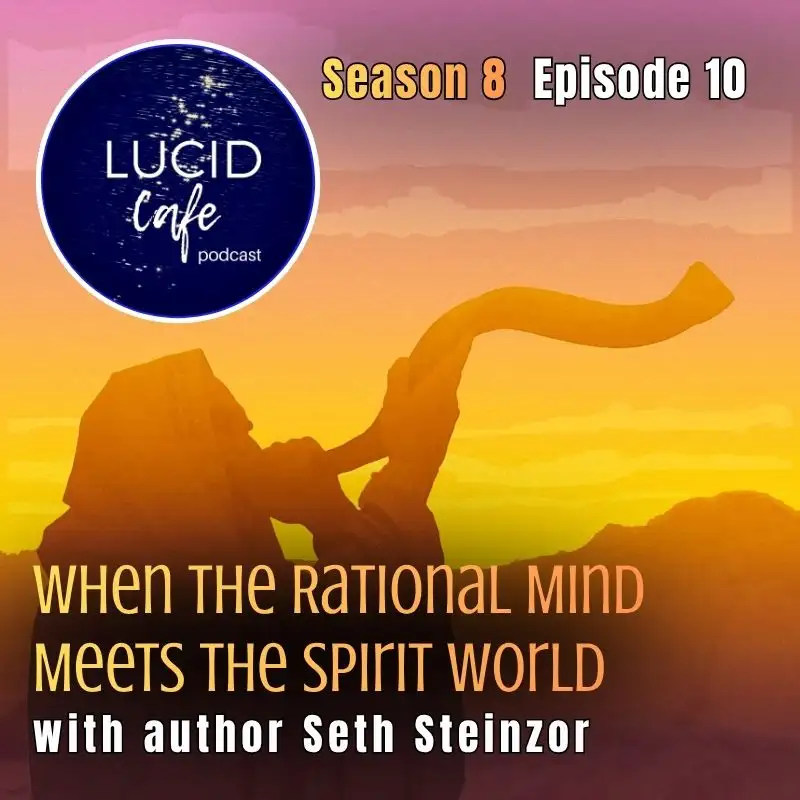
When the Rational Mind Meets the Spirit World with author Seth Steinzor
You're listening to Lucid Cafe. I'm your host, Wendy Halley. Hello, and welcome to another episode of Lucid Cafe, a podcast exploring healing, consciousness, and the complexities of being human. So have you noticed that I'm getting episodes out a little quicker lately? It's been a goal for well pretty much since I started the podcast eight years ago and so far I'm not drowning.
Wendy:I'll do my best to keep that trend going. If it stops, it's because I'm drowning, just so you know. Alright. In today's episode, I'm joined by Seth Steinzor, who recently released a book titled The View from the Other Side of My Head, which chronicles his experiences exploring shamanic trance. What makes Seth's story extra interesting to me at least is how opening otherworldly doors challenged his attorney trained intellect in ways that seem to flip his experience and understanding of reality on its head.
Wendy:In this candid conversation, Seth shares the highlights of his journey and some of the personal transformation that continues to unfold for him. So please enjoy my conversation with Seth Steinzor. Seth, thank you so much for coming on and talking to me about your new book.
Seth:Thank you. It's great to be here. I would say it's an honor and a privilege.
Wendy:Oh, really? Yeah. Wow. Okay.
Wendy:Well, I hope I don't fuck it up!
Seth:Me too.
Wendy:Alright! No pressure, wendy! So you've released a new book. It is called The View from the Other Side of My Head.
Seth:Yes.
Wendy:And I think what would be helpful is if you just start with maybe a basic overview of what this book is about.
Seth:Sure. The book is a kind of a chronicle of the first couple years of my early education in exploring shamanic trance. That's the really 25 words or less version of it.
Wendy:The elevator speech?
Seth:The elevator speech. It talks about it tries to talk about just the experience of being a, at the time, a man in his late sixties in our society, an agnostic leaning towards atheism from a Jewish background, someone trained in the law, in logical evidence based thinking, encountering this other window on reality that I had only vaguely suspected even existed before. And the real changes that it made in my life, And I should also add, I guess, although you didn't directly introduce me to this, the dream world, you certainly became my guide and teacher in focusing my exploration of it, for which I'm very grateful.
Wendy:Well, it's been very cool to kind of watch you go through this transformation that you eloquently report in your book. But before we get into your story about this, I'd love to hear about your version of what being agnostic or an atheist was or is because there's different ways to look at that.
Seth:Yeah, yeah. And I suppose part of the reason there are different ways of looking at that is just because we're all human beings with our different perspectives on things. But I think we're also at a particular point in the spiritual history or biography of our culture where all this stuff, so to speak, is just very confused. But to be more specific and personal, I grew up in a family that identified as Jewish ethnically and for culinary reasons, as our heritage, very much who we were in that sense. But I never entered a synagogue until, oh my gosh, well on into my life anyway.
Seth:There was no God in my upbringing. My parents gave me some sense of Jewish history and the major holidays and that kind of thing. But my grounding was entirely in the secular I don't want to say there's got to be a better word than materialistic, but materialistic is going to have to do because I can't think of that better word right now. Materialistic outlook dominant in our culture. Science may not explain everything, but it's the best system of explanation we have and exploration of reality that we have.
Seth:And Aristotelian logic is the way to think. And what you see in normal reality, you know, in normal consciousness, what you see is what you get.
Wendy:Yeah. Well, me dive in a little bit deeper because I wanna get a picture of where you sat from a spiritual perspective as a young person.
Seth:Oh, I had no spiritual perspective.
Wendy:Nothing. Okay. I just wanted to verify that. So you were at the end of the spectrum of atheism where when you die, that's it.
Wendy:There's nothing. Is that what you would describe?
Seth:Or That was one polarity, and it was probably the one that I was closest to. But I guess once I became aware enough of these questions to actually be thinking about them in any way, it simply seemed to me that there were no answers. And as one of the poems in the book says at the end, you know, When I die, I'm going to know.
Wendy:Yeah. We will or we won't.
Seth:Or we won't, yeah. When I die, a theory will at last have found its rest, is the way the poem says.
Wendy:That's well said, yeah. So it sounds like you hadn't really contemplated these bigger questions earlier in your life until you started to, then you kind of landed in this sort of more, it's all a mystery.
Seth:Unsatisfactory nature of our spiritual grounding and education and the spiritual bankruptcy of our culture generally, we did a lot of seeking. And I I don't like using that word we too much, talk about myself, but I think I'm typical in many ways.
Wendy:Well, there's some trends. Yeah. I guess you're referencing a trend.
Seth:Yeah. And so, you know, I read about Hinduism and Buddhism and some about the the Muslim heritage. At one point, I I was kind into new agey kind of stuff, you know, crystals and and my the woman I married had been her mother had been an astrologer. So I learned about that. And let me see.
Seth:Oh my gosh. You know, there was a variety of traditions.
Wendy:So you dabbled.
Seth:Dabbled. I explored, I was looking for something. I wasn't really finding it, but I kept on feeling like it was somewhere in there, but I couldn't access it.
Wendy:So what do you think it was that you were looking for?
Seth:That's really great question. That's a question that my best friend asked me when I told her about my exploration of shamanist trance. She said, Is this what you were looking for when you used to do drugs? And I said, Yeah.
Wendy:All right. That's pretty straightforward.
Seth:I'm a reasonably observant, reasonably smart guy. What I was able to access through ordinary waking consciousness was not telling me everything that I felt I needed to know, even about ordinary waking consciousness. And what I was looking for was that missing piece. And the received wisdom about God or the Tao or any of that stuff, it wasn't speaking to me in a language that I could understand. It was, you know, there was something there, but
Wendy:Didn't quite hit the mark.
Seth:Didn't hit the mark. Didn't correlate to my actual experience enough for me to say, Oh yeah, this is describing my world.
Wendy:Would you describe it as a sort of resonance? Like, when you hit on it, it would sort of have a harmonic resonance inside of you, like, Ah, that works for me, versus this other approach or perspective or philosophy doesn't?
Seth:Yes. Resonance. Yeah.
Wendy:All right.
Seth:That's a great word to use.
Wendy:So the thing that intrigues me is that there was something missing, and you were looking for something, but it sounds like you didn't quite know what you were looking for other than you would know it if you experienced it and it resonated.
Seth:I kind of had an idea what direction I should be looking in, but it was a very vague idea. And the words and concepts that had been passed down to me one way or another, either through my own family heritage or through these other things, they kind of made some general kind of they were looking at the same thing, maybe, that I was looking for, but they weren't telling me about it in a way that I could understand. And by understand, I don't mean just verbally and intellectually. I mean understand in that sense that you said, resonance.
Wendy:Yeah. Yeah, it's more of a felt sense.
Seth:Yeah. They didn't reach my head and my body.
Wendy:Right. But there is a sort of logic to it once you have the experience, but it's not the kind of logic that I think you're referencing. The intellectual logic. Right? Does that make sense?
Seth:Yeah, yeah. Logic is a funny word to use in this context. But yeah, but there is.
Wendy:It's a form of logic.
Seth:I'm hesitating because, so now I have been exploring the dream world for at least five years anyway, consciously exploring it. There is a logic there. Still have no idea what that logic is. I still have no idea really about what most of the stuff is that I'm Well,
Wendy:that's your brain wanting to understand something that's ineffable.
Seth:Yeah, and that may be my personal struggle with it. Other people may be more just accepting of, Oh yeah, there's this fox there that is helping me write poems. Or, you know, there's this, to name another example that someone gave me, there's this square headed duck that tells me about stuff. For me, given my biography and my training and just my mental disposition
Wendy:Your culture. And my culture. I mean, our culture, I should say.
Seth:And I'm, you know, almost despite myself, I'm very much a product of our culture. Yeah.
Wendy:We all Yeah. It's becoming more and more obvious, it seems, as things start to unwind. Yeah. All right. So how did you get introduced to shamanism?
Wendy:I know you cover this in your book in great detail, but just for the sake of this conversation
Seth:It's a story I don't get tired of telling. I was working as a lawyer in the Vermont Attorney General's office. And I had a friend who I was getting to know, who was just really this brilliant, charismatic, dynamic person. And she came to me one day, and I'm sorry, the friend was a colleague in the AG's office, I'd say that. Too was a lawyer.
Wendy:I believe she still is!
Seth:Although she doesn't work in the same position. Anyway, came to me one day and said, can you help me with a homework assignment? And I said, What's this homework assignment? She said, Well, I'm supposed to find someone's power animal. And I said, Fine.
Wendy:Really? That didn't strike you as odd?
Seth:Well, of course it struck me as odd. It was odd. But I was willing to go along for the ride. I've been kind of a lifelong seeker in some ways.
Wendy:It piqued your curiosity a bit?
Seth:It piqued my curiosity. I had some kind of vague idea that there was such a thing as a power animal, and I didn't have any really clear idea what that was. But anyway, so I said, Yeah, sure.
Wendy:Why the hell not?
Seth:Let's do it. No idea what this would require of me. She had framed it as she was going to find a power animal. So great, I'm going to get a power animal. And so she explained to me what a power animal is, which was different from what I had thought.
Seth:And she explained to me somewhat of what she was going to do to find this power animal. And then she said, But you have to tell me something in order so that I can do this. You have to tell me where you feel your weakness, where you feel your lack of power, where that lies in you right now. And that took me a little bit aback because I hadn't been expecting to have to do any heavy lifting. And then the question arose, because this was a new friendship, you know, what level of intimacy
Wendy:Very true. She was asked That's a pretty deep question, intimate question to ask someone you don't know very well.
Seth:I'm being asked where's my vulnerability.
Wendy:And it's just a homework assignment.
Seth:Just a homework assignment.
Wendy:No big deal.
Seth:But I decided what the heck. In for a penny, in for a pound.
Seth:This was at the time of fairly late in the first Trump administration. And the triggers of my weakness, my sense of weakness, were related to that. I was strictly speaking not talking about political stuff. I was talking about what the political environment at that time was triggering in me, which was a lot of, frankly, panic and terror and fantasies of violent aggression. And although there was never any serious chance that I was going to act on any of that, but it was making me feel in ways that I was not comfortable with and making me feel like this was not a person I wanted to be.
Seth:This was not how I wanted to meet the times. And it was very difficult to dig myself out of that. And so that's what I explained to my friend Samara. And she So she then went and undertook her journey to retrieve my power animal.
Wendy:Did she do it in your presence? Or did she do it away from you?
Seth:No, this was all away from each other. This was at the beginning of COVID.
Wendy:Oh, okay. So yeah, definitely away from each other.
Seth:It was a lot over the phone and texting. But when she brought my power animal back to me and told me about the journey that she had been on to find the power animal, I don't know, was just kind of really intrigued by the aptness of not only what she found, but how she had found it and what she described it as consisting of and how she described it. It just all seemed to me like one way or another, yeah, if I had a power animal, this would be the power animal that would be right for me. I don't want to give away spoilers here too much, and I don't really talk about this explicitly in the book, but careful readers will probably see it. The power animal that she found for me, mama bear, black bear and two cubs, was apt in ways that I couldn't even imagine at the time.
Seth:Yeah. And so I don't know, I think maybe subconsciously that also figured into my reaction, hooked me. I mean, I wasn't aware of that, but I think that was a factor in my response.
Wendy:It resonated on some level-
Seth:on some level
Wendy:that you were not completely aware of yet, but would come to discover later. Makes sense.
Seth:So I said to her, you teach me how to do that? And she said, Sure.
Wendy:So you were definitely intrigued right off the bat.
Seth:Hey, it was definitely cool, you know.
Wendy:Was that a different kind of response in your seeking than you had found in the past, or had you had close calls like this before? Like, maybe this is something my curiosity has piqued. I wanna explore this some more. Or was this different?
Seth:This was different. And that's why I bring up the part about the hidden aspect of the aptness of mama bear and her two cubs, that resonance that I felt without knowing I was feeling it. I just felt like there was something there for me that I wanted to know more about. One of the things I had learned over the years was that sometimes you get these kind of focuses on things that don't make a lot of sense and come to you out of nowhere, but still something comes into your field of awareness and you kind of focus on it for a while. So for example, at one point in thinking about my Jewish heritage, this was years prior, I had decided, you know, in learning more about this, I'd really kind of like to experience what it is to blow a shofar.
Seth:A shofar is a ram's horn that gets blown as part it makes a musical sound, a very loud musical sound. And it gets used for that in several Jewish holidays and celebrations. And I thought, well, to kind of get a little bit more in touch with that aspect of the tradition, I need to have a shofar to get the feeling of what it's like to use this thing and what it sounds like and what it feels like. So I got one after having this itch to get one for about a year because it made no sense. What am I going to do with this shofar?
Seth:I don't go to synagogue. Don't really celebrate these holidays. I don't really have an ongoing regular use for the thing.
Wendy:But you
Seth:felt the pull. I felt the pull, yeah. And so I got one And I learned to make a sound on it, make musical sounds on it, fine, and then I hung it up on a wall in my bedroom, and there it sat for a number of years.
Wendy:This is prior to this experience and connecting with
Seth:your But bare so you these itches and sometimes when you scratch them, you get something out of it. And I had gotten something out of the shofar and certainly it was a pretty object to have hanging on my wall. So this was another itch and I wanted to scratch it. And I wanted to scratch it rather more powerfully than I had wanted to scratch the shofar. And of course, tied up into that was this nascent friendship with Samara, which was not a romantic friendship, but she was somebody who just personally really intrigued me.
Seth:She was a fascinating individual. And so, it was part of getting to know her too, and getting closer to her.
Wendy:Okay. So then, you have this experience, and then you ask Samara to teach you how to do it? Yeah. She
Seth:didn't actually teach me how to find somebody's power animal. That's something I'm going to ask you later. But she taught me how to enter the dream world. And I did. It took a certain amount of persistence.
Wendy:Why do you say that?
Seth:Well, to some degree, it's a skill.
Wendy:It is. Yes, it is. But for anyone who might be listening, I think it's an important piece of this if they are intrigued by a shamanic practice.
Seth:Well, in our society, we don't go there, so you gotta learn how.
Wendy:So there's no cultural context
Seth:There's no for cultural context for it.
Wendy:And we also are, as I kind of alluded to a little while ago in our conversation, we're very head centric. We're very kind of wanting to stay in the problem solving mode and wanting to understand why does this happen the way it does or Exactly. In a journey, you can't access this place from your head, But most people are trying to because that's where they're most comfortable.
Seth:Very much so. And I would also add to that, because this is my abiding struggle with it, is verbally. I'm always trying to create verbal descriptions of what's going on when I'm there, which just so gets in the way of actually experiencing
Wendy:I can relate to that.
Seth:To a certain extent, you can't help that because part of our normal consciousness is to make verbal descriptions of what we're experiencing.
Wendy:Right. And for those of us who are doing this level of shamanic work to be of service to others, we have to be able to articulate what we perceive.
Seth:I think even to be of service to ourselves.
Wendy:Very true, yeah. So the brain is part of it, but it's not the part that initiates. It's not the perceiver, it's the understander of the perceptions.
Seth:Trying to define prematurely what these visions and experiences that you're having in the
Seth:dream- world really gets in the way of the dream world telling you what you need to know at that point. It gets in the way of being able to take it in. Anyway, and a large part of that was just running up against the obstacles, which I'm always running up against. I got there. There was this one day in particular when I So this talks about my particular procedure.
Seth:I don't think there's any one way. This is the way I do it. And the way I do it has involved different things at different times, but at that time, it involved going through this kind of ceremony of getting into the right frame of mind.
Wendy:Which is let me just add a little caveat here that that is actually super important because it tells your unconscious mind that something important is about to happen, so it is a great way to prepare. Yes. That's why most of us do have some sort of practice, whether it's burning sage or rattling or calling in the directions. You're kind of setting the stage, and that practice kind of tells your unconscious mind that we are preparing for this adventure we're about to have in the dreaming realm.
Seth:Absolutely true. There's a Jewish concept, actually, that prayer is ineffective unless it has a certain frame of mind behind it, which is called kavana. And I think it's a similar concept. You have to be mentally in the right place. So I do continue to have a ritual that I go through in order to start my process of entering the dream world.
Seth:At that time, I was trying to figure out what that ritual might be. Because there's all sorts of sources that would tell you, Do this and do this and do this.
Wendy:Gotta get right. You gotta get right.
Seth:There is no right
Wendy:Exactly. Thank you.
Seth:Right way is Thank your you. You have to do it. I mean, there has to be something, I think. So anyway
Wendy:It does help, yeah.
Seth:It helps enormously. Actually, just to kind of loop around to something I was talking about earlier, one of the things that has persisted throughout all the iterations of my various rituals of getting into the one that has lasted the longest is I blow on the shofar to
Wendy:I was wondering if there would be a callback to that. Because it makes sense, right? That you would be drawn to something and think it was for one reason, and then come to find out later, it actually is playing a bigger role related to your ancestry, which is beautiful. That's very freaking cool. And who is?
Seth:Yes. Because one of the huge things that happens happened to me that has happened to me is a new depth of connection with my heritage and ancestry. Probably not in the way that most of my ancestors would have preferred initially, but they seem to be okay with it now. Anyway, so there was this one day I got through the veil. There's at least in the first times that you go to the dream world, there's a thing you have to get through, and I can't use a more precise term than that, but there's a at least for me, I'm always talking about just me.
Wendy:Right, and I don't think everyone has that level of experience, unless they're accessing a specific part of the dreaming realm or dream world.
Seth:Well, for me to get to the dream world, at least this doesn't happen anymore. But at first, there was a transitional phase, you know. You're experiencing ordinary reality. And the way I did it, lie down, you put on your earphones so that you can listen to the drumming that's going to propel you into and carry you through the dream world. And your mind goes through this liminal transitional space, and then you're there.
Wendy:Well, maybe you too, you're unconscious because who you are needed a veil in order to distinguish the difference between physical and dreaming realities.
Seth:Oh, yeah. I haven't thought of that before. Very good.
Wendy:So it's a symbolic representation of, okay, we're going from this reality to a different reality.
Seth:Going from here to here, there's a place in between.
Wendy:And my brain feels happy about knowing that that's a differentiation, a boundary of sorts.
Seth:That's a great way of putting it, and it actually sheds light on things I've experienced since, including fairly recently. So this particular time, I just got there, and I got to this place that I'll call the garden. And it was, for me, it was a clearing in the woods. And I was in a clearing in the woods. I mean, I can't describe it any better than that.
Seth:I was in a clearing in the woods. And I walked around some and I looked around, and there was a house near the clearing that was that carried some kind of freight, emotional freight that I later would explore. I saw a few things and then it was time to come home. And I came home to my normal, ordinary self. And it sounds like a very nothing experience when I describe it in those words.
Seth:And I went to a place in the woods, and I saw myself walking around in it and saw a house, and I came. But it was earth shattering to me because there was a feeling of all this stuff that I had seen. First of all, it was a clear, detailed vision. And there was a feeling that it all existed independently of my imagining it. That it was in some sense, and I'm still trying to figure out what that sense might be.
Seth:But in some sense, it was real and independent of the entity I normally think of as me. It's just there.
Wendy:How could that be?
Seth:How could it be? And what the heck is it?
Wendy:Yeah. So your curiosity was piqued even more?
Seth:Oh my god, yes. Whether I'm just exploring something in my own head, or I'm exploring something that exists outside of my head and I'm just perceiving it, there is this whole reality there that I am, until now, only in the very, very, very vaguest sense aware of. And it just feels like whatever it is I've been looking for, it's there.
Wendy:Okay. So you got this kind of introduction to the idea that maybe reality is a little more complicated than I previously thought.
Seth:Oh, yeah.
Wendy:Okay. And therefore, maybe I am. Yes. There's more to me than just this sort of physical existence that I've been living.
Seth:Well, I wouldn't put it exactly that way because I do believe that we are physical creatures we live in a physical world. That seems pretty real. So I'm not I think the thing that's unclear to me is that thing that I don't know. Mean, you have way more experience with this stuff than I do. So the question that's framing itself in my mind ever since is, am I experiencing oh, God.
Seth:I don't know how to talk about this.
Wendy:Give it a shot. Go ahead.
Seth:It goes back to that feeling of independent reality.
Wendy:And what are you referring to as independent reality?
Seth:Well, in the dream world, what am I looking at? Am I looking at simply stuff that is being just generated entirely within my psyche? Or am I actually perceiving, or am I actually becoming conscious in a new way of perceptions that I did not previously have access to about the world outside me? I'm tending more and more to think it's that latter. And I'm also tending to think that those two things are not mutually exclusive.
Seth:They're actually the same thing. And this is actually kind of just extending and verifying a perception, I guess perception is an idea that came to me very early on, which was that there is a continuous process going on inside my head and that of everybody with a bifurcated brain, which is every human being. There is a continuous process going on inside our head of which we aren't ordinarily aware, but which provides us with guidance and orientation and understanding of ourselves and the world around us, and the relationship of ourselves to the world around us. Helpful. That is helpful, more than helpful, that is essential to our survival.
Seth:But we are only very tenuously and indirectly aware of it in fits and starts, unless we consciously go to the dream world, then we're seeing it. Okay.
Wendy:So that may be by design, right? That being aware of that all the time probably wouldn't be very helpful.
Seth:Probably not.
Wendy:But I mean, far as your functioning in the physical world.
Seth:But then, you know, so the next step in my exploring this was being me, I started just reading up. One of the things that one quickly becomes aware that I quickly became aware of, especially through Mircea Eliade's incredible book, Shamanism, is that in human history up to, I don't know, maybe the last one thousand, two thousand years, access to this other perspective was accepted as part of the norm.
Wendy:Yeah, exactly. That's well said.
Seth:We have lost or abandoned it in our history and culture. That may have been also kind of necessary in a way to develop the I'm speculating about things I don't really know that much about, but it may have been necessary in a way to develop the analytical tools and material knowledge that we have developed because the dream world doesn't talk about this stuff in a way that's particularly technologically useful. The dream world gives you tools that you need. And I think it continues to do so in each of us, but it doesn't tell us, say, how to design a car.
Wendy:Or does it?
Seth:Well, not in the terms that we find most useful.
Wendy:I don't know. I mean, because you think about like the biggest discoveries are usually coming from daydreams or nighttime dreams.
Seth:No, that's true. You got to think about the benzene ring and how that was discovered. So I mean
Wendy:yeah.
Seth:I mean, I may be overstating the case then.
Wendy:But I get what you're saying, though, is that we have been kind of conditioned away from accessing these parts of ourselves, these more transpersonal parts of ourselves, and focusing more on the physical reality and the survival dance and understanding, making sense of following along with the status quo, with all of that. But yeah, the indigenous people would, in general, suggest that the dreaming world is the real world. That's why when you access it, it feels hyper real.
Seth:Yes.
Wendy:And then this physical reality is the dream.
Seth:And, you know, the first time I came across that idea, I said and I think I say this in the book actually because the book was written about my state of mind back then. I said to myself, Oh yeah, no, I don't think so. I think there must be no more equal. There's this reciprocal relationship. More and more, would be tempted to agree that, at least from my experience, in some sense, the dream world is the more potent of the two.
Wendy:Right. Yeah. Yeah. So I think it's something that you can only kind of probably get to that place through direct experience. It it intellectually, it makes zero sense.
Wendy:And because your physical life sure as hell feels very real, and I think that's supposed to be the case, because if you knew you were dreaming while you're dreaming, then what would be the point of the experience? But I do like the idea of becoming lucid while you're in this experience.
Seth:Yes.
Wendy:Imagine walking through your everyday physical existence knowing that this is a dream, and then you can start transposing your experiences symbolically as opposed to I mean, it gives you a little bit of a little bit of distance from it and helps you to maybe make a different sort of sense of why things are happening the way they are. Just that's where I land.
Seth:No. And what you're saying resonates there's that word again resonates with me in that it brings up just the Buddhist concept of detachment, which is not the same as you know, indifference or distance. It's more like that sense of bearing witness. You're bearing witness to your life. You're bearing witness to the world around you in which your life occurs.
Seth:You're bearing witness to all these other beings that are equally, you know, going through their lives as you do. Right. And the relationship among all those things. And that to me is another way of framing, I think what you're talking about is lucidity in the dream world.
Wendy:Or in the physical world.
Seth:Or in the physical world.
Wendy:That's what I mean is being lucid while you're physically...
Wendy:Because when you're asleep and you're dreaming, and you're aware that you're dreaming while you're asleep, you're lucid.
Seth:Yep.
Wendy:And so if we are dreaming while we're physically awake, a little trippy there.
Seth:No, no, no. I get that.
Wendy:You become a different kind of lucid, but like with the Buddhist concept that you're referencing, and this concept, it's the same idea that you can't be there all the time, though. You can't stay in that because you're living your life. You can't be thinking about how you're dreaming while you're driving. No. Because you could really cause some problems.
Seth:You get after the dream world permanently.
Wendy:Yeah, exactly. So you open these doors, you have this experience that really gets your attention, And so you start diving in deeper, and you start learning how to journey, and you start journeying with Samara.
Seth:Yeah.
Wendy:I'm just doing a little cliff notes here. Journeying with Samara on a regular basis, and until you, I guess, decide that you want to go a little bit deeper or understand some of the things, you're getting stuck.
Seth:Yeah. I mean, I I trying to put myself back into the frame of mind I was in. And the frame of mind I was in was that I was kind of like an explorer who had just set foot onto this enormous continent. And I didn't know where to go. I had context for any of it except that Samira could give me, but she was a student herself in the sense of, you know, she's just learning.
Seth:So the things she said made sense, but they didn't really give me a great sense of direction. And I did various reading because there is a pretty substantial literature about But I didn't find nearly any of it helpful. A lot of it is just this how to stuff and it's telling me, you know, it's like cookbooks and it's telling me, here's how you do this and here's how you do that. It was like, no, you know, it's not what I'm doing. Anyway, all the rest that I was able to encounter at that point anyway was very anthropological, which is fascinating in its own right, in lots of ways, and mind blowing in its own right in lots of ways.
Seth:But again, it wasn't telling me what I needed to know about what was happening within me, except in a very kind of intellectual abstract way. That wasn't what I needed. What I needed was, you know, how do I get further into this continent? Which is the best way to explore? And so I kind of figured I could stumble around forever, figure that out, or I could get a teacher.
Seth:And Samara had a teacher.
Wendy:She did?
Seth:And that was you.
Wendy:Big old weirdo teacher!
Seth:That's not how she described you. Anyway, I made my way to your door, and found what I was looking for there, which was somebody who could sit down with me, hear what I was experiencing. Ask the right questions so that I knew how I wanted to follow-up. Allay my considerable fears and anxieties, or answer them anyway.
Seth:And so that was the next step for me.
Wendy:The next phase of your experience.
Wendy:No, and what I love about your experience and your story is that you are a great example of how this practice is innate to all of us, even though your brain was getting in the way a lot of the time.
Seth:Still does.
Wendy:Because it wanted to understand. I mean, that's how we're wired in our contemporary culture. Because, like you were saying, referencing the shamanism book you read, the one that really got your attention about how this practice was universal in the world. Almost every culture comes from a shamanic tradition, and they're all doing this same version of the practice, altering their consciousness, accessing this other realm, connecting with helping spirits in this other place who are giving information and doing healing work and all of this kind of stuff. We are so far away from that.
Wendy:And so it is not super easy for us because we're so far away from it to access these realms. And I love that you captured your process in this book because it's representing what a lot of us struggle with if we want to explore this practice.
Seth:Thank you. Really wonderful to hear from me because it was really the impetus behind writing the book. I did not want to write another how to book, and I didn't want to write another book about shamanism. Because for one thing, I don't really know what shamanism is. That's my my little word?
Wendy:Well it's a word we use now to describe this ancient practice. It's, I mean
Seth:Well, I'm not a shaman.
Wendy:Neither am I.
Seth:I would question that.
Wendy:My philosophy on that is what I was taught, and I highly agree with my teacher's perspective in that is that you don't call yourself a shaman. If you demonstrate the skills, then the community can call you that.
Seth:Okay. No, that is very true. And one thing I think I have learned pretty well is that if somebody is calling themselves a shaman, In they're not
Wendy:the other direction.
Seth:Yeah. Anyway, I don't want to is not a place that may be too productive to go.
Wendy:Or it is.
Seth:Or maybe it is.
Wendy:It's a cautionary tale.
Seth:I would call you a shaman because traditionally, one of the roles of a shaman is, as a healer in the community, They use their access to the spirits and to the dream world to determine what needs healing and to enlist the spirits to help heal it. And that's what you do. So, you know, that seems to me shaman and, you know, but I don't want to put labels on you that you're not comfortable with.
Wendy:Oh, no. I mean, if I've earned it, then wonderful. If I haven't, then I accept that as well.
Seth:From this particular segment of the community sitting in front of you, I think you've earned it.
Wendy:Okay, that's kind. Thank you, I appreciate that. But getting back to your story, how would you describe the impact this shamanic practice has had on you?
Seth:Oh, it's been transformative in pretty much the way you describe. Although I would add to that, it hasn't transformed me from who I was to something else. It has supplemented that. It has made me more by giving me access to more. So what do I mean by that?
Seth:I mean that I have access to and I'm learning about a whole other way of perceiving reality. There is only one reality, I mean, as far as I can tell. There is not the reality we live in from day to day and this other reality out there that's somehow separate from that. It's all part of a single system. That's what my experience is teaching me over and over again.
Seth:But before I discovered my way into the dream world, I was only perceiving, you know, let's say half of it. Yeah, okay, you made a gesture that probably more accurately describes it.
Wendy:A tiny bit.
Seth:Okay, so now I have access to perceiving a huge amount more. And potentially, if I can learn how to understand it and not to get in my way about perceiving it, to have access to it in a useful way. A concrete example of that is that my poetic practice I'm a poet. I have been since I was, I don't know, five years old. My poetic practice has been transformed, deepened.
Seth:I feel closer to where the poems come from and how to hear them when they come to me and how to put them into words when they come to me. I'm more comfortable in my skin and my body. I don't think the book talks about that because that's a more recent development. I have encountered a spirit in her frame of reference, she's teaching me how to dance, which involves just being aware of the dance that is always going on inside my body and being consciously part of that. There's that sense that I was talking about that I had been reaching for so many times, but had never found of being connected to the world in a way that you have to experience to really get, but it's the sense of being, again, one node of consciousness in the middle of a constellation of an infinite number of nodes of consciousness, all of them equal, all of them acting together, all of them connected just by being here at the same time.
Seth:And that gives me chills just saying Of maybe of particular relevance to someone of my age, a new relationship to death. It's still a fearful prospect because, you know, who wants to go through that?
Wendy:Well, the physical experience of death, you mean? Like that?
Seth:Yeah. Well, and also because in my mind, there is always the doubt as to what type of reality my vision and understanding gained through the dream world consist of.
Wendy:Fair.
Seth:Because I don't know, and that's true. That caveat is true of everything that I encounter so far.
Wendy:Well, that's also fair.
Seth:And to risk further going on this digression, because our culture does not have consensual approach to what the dream world tells us. It's explored very much on an individual basis. And we have contexts in which to put this stuff that have been received from cultures that we don't really understand. So it's just like, you know, yeah, somebody's talking to me, but I don't know what the words mean and I don't know what they're referring to.
Wendy:It's a lost art, and we don't have a language for symbolism.
Seth:Not a good one, no. Boy, I'm really going down this rabbit hole, but why not? I read a book recently by Davy Kopinawa, who is a shaman from an Amazonian tribe. And it is just about him being a shaman and what that involves. And boy, all the stuff he talks about makes real concrete sense to him.
Wendy:What about to you?
Seth:To me, it says that it makes real concrete sense to him. But but I I can't translate it. Mhmm. You know? I mean, it's that somebody put it into English words, but
Wendy:Well, I mean, that speaks to... not to go too deep into this in this conversation, but what I think you're referencing, at least from my experience, and all this stuff I'm saying is from my experience, take it for what it's worth, but that it does make me wonder why we perceive what we end up perceiving in each of our individual journeys. It seems to me very personal. There are archetypes that we encounter that are helpful, but it's like, why do I perceive a specific archetype? Or why do I perceive this particular animal or this particular plant spirit or this particular why is this particular memory showing up in my dreaming realm experience or whatever. I mean, there's a part of us, there's an intelligence that's not the kind of intelligence that we're typically referencing that I think is helping us along, and then we just have to kind of make sense of it.
Wendy:And it can make sense on a very visceral level, but not always an intellectual level.
Seth:Part of that, a large part of that is just this cultural thing. In Davy Caupanawa's world, when he talks about, oh, I don't know, these little spirits that he sees coming down from the sky that are like little flakes of shining dust and there are millions of them, Somebody else in his culture is going to know what he's talking about. And he's going to be able to talk to somebody else about that and they're going to be able to give a concrete meaning to that concept. They know what he's referring to with those words. We don't have that to work with.
Wendy:Yeah, it's true. We're just doing it on an individual basis.
Seth:People are just making it up as they go along. So that's exciting. It's incredibly exciting because also we may find things that people who work from a more established culturally determined framework may not be seeing. But boy, it makes things more difficult anyway. So coming back to the death thing, I mean, so one of the journeys that I undertook at your actually, through following a guideline that you provide in a workbook that you wrote, was to go to the upper world.
Seth:And it's a very transhuman place. Let's put it that way. And it's a place where there is no time, there is no space, and yet there is duration and motion. So try to put that together in your head. And just unbelievable luminous beauty, and the sense of belonging and peace, and the sense that you talk about, you know, is the spirit world real or is this physical?
Seth:That's the real world. That's the real world.
Wendy:You're talking about the upper world?
Seth:The upper world.
Wendy:Yeah. I call it home.
Seth:Home. Yeah, exactly. It is home, but it's the essence of home. If that journey could have never ended, I would have been okay with it. It's just like I remember lying on my bed after that journey was over, watching the remnants of that vision kind of dissolve and disappear.
Seth:You'd think I would have felt sadness, but it's there. It's there.
Wendy:I can go anytime.
Seth:I can go anytime. I haven't gone back though because it's so freaking powerful. It's a little scary to me. But the other part about going back is there's this strong feeling that that's where you're going.
Wendy:You mean when you die?
Seth:When you die.
Wendy:Yeah.
Seth:I certainly hope so because I'm down with that, man.
Wendy:If that's the place?
Seth:If that's the place, then I'm okay with it. It's kind of like I said in that poem long ago, you know, when I'm dead, a theory will at last have found its rest. Well, this is the theory I'm pretty happy with.
Wendy:So would you say in the conclusion of our conversation that you have landed on at least a practice that has helped with your spiritual life or develop a spiritual life of sorts?
Seth:Oh, absolutely. And in so many other way, mean, we haven't even gone into some of the other ways. But yes, in every aspect of my being, I don't hesitate to say that, I feel enriched and strengthened and stabilized. And I still feel like just a beginner. God knows where this is going to.
Wendy:Join the club.
Seth:It's a great feeling.
Wendy:No, that means there's just so much more to explore and to discover.
Seth:I think it's unending.
Wendy:It's such rich territory. For me, it's added such depth to my lived experience. It's beyond words. I can't really describe, but in that is offered a degree of peace that I can get away from. But when I go back there, it's there all the time.
Wendy:It's like, Oh yeah, that's right. If this lived experience is just a dream, then how do I want to be in relationship with that dream?
Seth:What a beautiful way of putting it. Yeah. And that sense that that's more than a sense. The knowledge that this is not something you just pop into and out of, it's actually there all All the the time.
Wendy:It's just a matter of where you tune your focus. It is interesting how it's changed how I see things, and in ways that I'm not even sure it's so subtle that it's just sort of organically happened. It's kind of like what I like to say is that you can't have a conversation with a tree and be the same after that. It's like every tree you see after that, whether you're aware of it or not, is going to be a little enhanced.
Seth:Absolutely. Absolutely. You're referring obliquely to an episode in the book. You can't have a conversation with a tree. You can't experience satori.
Seth:You can't go to heaven. I mean, you know, you can't meet and reconcile with a long dead relative whom from whom you had been deeply estranged. You can't be put into a tutelary relationship with your ancestors. You can't have any of that happen without it changing you. You can't have a fox saying, Why don't you write a poem about this?
Seth:And here's what the poem's going to be. You know, you can't you're talking direct about experience. And cumulatively, it really changes you.
Wendy:Yeah, exactly. That is the nature of this practice is that it is transformative in ways that are surprising and subtle, but very potent and and very personal and intimate.
Seth:True that.
Wendy:Yeah. Well, Seth, where can folks find your book? Oh, your books because you've written
Seth:Well, I
Wendy:yeah. Poetry books and
Seth:Well, I guess online is probably the best way to find them.
Wendy:So you don't have a website?
Seth:I do have a website. I don't sell the books through the website. The publisher of my earlier books, In Dante's Wake, which is a trilogy of retelling Dante's Divine Comedy in verse, that's available through most online sources. The View from the Other Side of My Head is published by Green Writers Press. And if you go look at my page on their website, it gives you some suggestions as to where you can buy it.
Seth:Don't think you can order it directly from them, but they they refer you to places you can get it from.
Wendy:Which makes sense. You can probably order it from any bookstore Yeah. Unless it's on the shelves, or any online retailer is my guess is how they have it that their distribution is set up.
Seth:I believe so.
Wendy:I will add a link in the show notes to the page on your publisher site so folks can check out your book. Well, thank you very much for coming on and talking about your experience.
Seth:Thank you for the opportunity. This has been great.
Wendy:I wonder what Seth's former colleagues at the state of Vermont attorney general's office would make of his experiences. I couldn't help but think of that the whole time. I think it's very cool that Seth felt moved to share his experiences as a book. If you'd like to get a copy of The View from the Other Side of My Head, I've included a link to the publisher's website in the show notes. And if Seth's story inspired you to explore shamanism, last year I released Become Your Own Shaman, which is a self paced experiential online course designed to give you pretty much everything you need to begin your own personal shamanic practice.
Wendy:It's rooted in the indigenous Hawaiian spiritual teachings shared with me during my early apprenticeship. This course offers a profound yet accessible entry point into shamanic work. We'll explore the nature of reality, consciousness, and the self. You'll learn to safely enter shamanic trance through sound, and connect with two of your spirit guides. To take the first step toward deepening your connection to the unseen and to your own spirit, please visit lucidpathwellness.com.
Wendy:Thank you for joining me. Coming up, we'll continue to explore liminal spaces and see where they take you. Until next time.